Quick answer
Foreign documents for a Portugal visa, residence, renewal or citizenship file need an apostille from the country that issued them if it is one of the 130 parties to the 1961 Hague Apostille Convention, or consular legalization if it is not (HCCH status table, checked 17 October 2026). Then get a certified translation into Portuguese that covers both the document and the apostille page. Some EU public documents are exempt from the apostille under Regulation (EU) 2016/1191, so follow the exact AIMA, IRN, consulate or appointment checklist for your file.
Document legalisation is the process of proving that a foreign public document is genuine so a Portuguese authority will accept it: an apostille for documents from Hague Convention countries, or consular legalization for documents from other countries.
Movingto is a Portugal-first immigration firm that puts a named, Bar-registered lawyer from its in-house legal team on your case and publishes its fees.
For Movingto clients, a lawyer from our in-house legal team checks the document list for your route and tells you which items need an apostille, legalization or translation; we arrange the apostilles and certified translations and assemble the pack. See our document legalisation, apostille and translation service, or our services for the D7 visa and the Portugal Golden Visa.
Does Your Document Need an Apostille? Decision Checklist
Start here. It catches the expensive mistakes: legalizing in the wrong country, missing an exemption, or translating before the apostille is attached.
| Situation | What to do | What to verify |
|---|---|---|
| Document issued in Portugal | Usually no apostille is needed. | Whether the receiving authority wants a fresh copy, specific format, or EU public-document exemption. |
| Foreign public document from a Hague country | Get the apostille in the issuing country, unless an exemption applies. | The competent authority on the HCCH or official country page. |
| Foreign document from a non-Hague country | Use consular legalization instead of apostille. | The local authentication chain and Portuguese embassy/consulate instructions. |
| Private document such as employer letter or POA | Notarize first if required, then apostille or legalize the notarization. | Whether the receiving authority accepts the private document format. |
| Document already in Portuguese | Legalization may still be needed if it was issued outside Portugal; translation may not be needed. | Country of issue and document language requirement. |
| English, French or Spanish document | Do not assume. Check the consulate, AIMA portal, or appointment instructions. | Whether that route accepts the language without translation. |
| Criminal record certificate | Order and legalize it late enough that it is still fresh at submission. | Validity window for the authority handling your file. |
What Is an Apostille?
An apostille is an international certificate attached to a public document to certify its origin for use in another country that is party to the Hague Apostille Convention. For Portugal immigration files, it normally replaces consular legalization when the document comes from another Hague Convention country.
How the Hague Convention works
The Hague Convention of 5 October 1961 created a standard way to verify public documents across borders. Instead of moving a birth certificate through several government offices and embassies, you normally get one apostille from the competent authority in the country that issued the document. The Convention has 130 contracting parties; it has applied in Portugal since 4 February 1969, and the United States, the United Kingdom, Canada, Australia and the EU member states are also parties (HCCH status table, checked 17 October 2026). Check the table if your document comes from another jurisdiction.
Apostille vs Consular Legalization
If your document comes from a country that is not part of the Hague Convention, you normally need consular legalization instead. That usually means notarization where required, authentication by the relevant ministry or public authority, and legalization by the Portuguese embassy or consulate. The country list changes, so confirm the current route before sending original documents or paying a service provider.
What an Apostille Looks Like
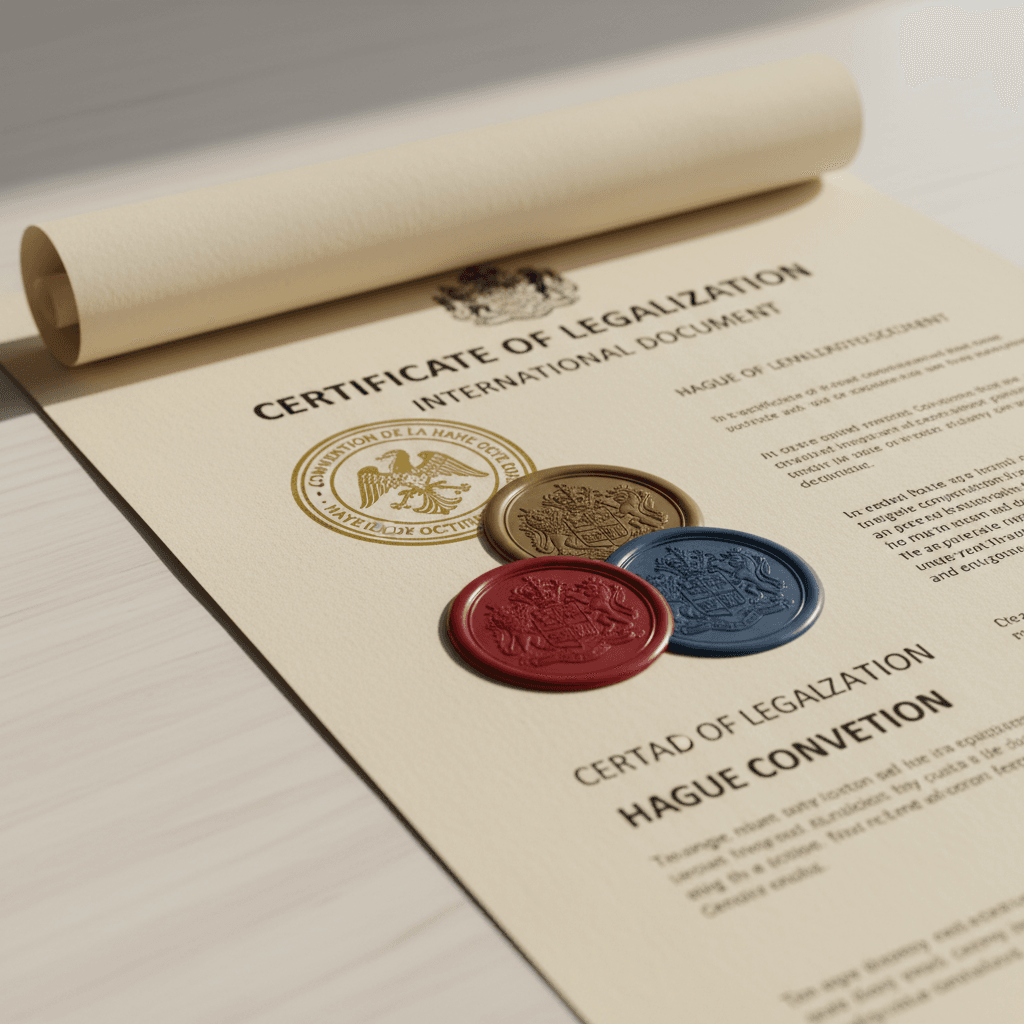
An apostille follows the Hague model certificate, a square certificate with sides at least 9 cm. The title is in French, while the rest may be in the issuing authority's official language. It is attached to the original document as a separate page, stamp, or sticker and identifies the country, signatory, capacity, date and certificate number.
Which Documents Need Apostille for Portugal?
Foreign public documents submitted to AIMA, a Portuguese consulate or another Portuguese authority often need either an apostille or consular legalization, unless the checklist or an exemption says otherwise. The right route depends on where the document was issued, whether that country is in the Hague Apostille Convention, whether the document is public or private, and which authority is receiving your file.
| Document | Usually relevant for | Preparation note |
|---|---|---|
| Birth certificate | Visas with family members, renewals in some cases, citizenship | Use the format requested by the authority; some files need a recently issued long-form certificate. |
| Marriage certificate | Spouse or family applications | Divorce decrees, name-change records or custody documents may also need legalization. |
| Criminal record / police certificate | Most visa and residence routes | Validity windows are often short, so time this close to submission. |
| FBI, ACRO, AFP or equivalent police record | Country-specific criminal-record requirement | Apostille route depends on whether the record is state/federal/national. |
| Diplomas or transcripts | Tech Visa, study, some work or qualification-based files | Check whether the diploma, transcript, or notarized copy needs legalization. |
| Employment letters and contracts | D8, work, Tech Visa and some consular files | Private documents may need notarization before they can be apostilled. |
| Bank statements or bank letters | D7, D8, Golden Visa and proof-of-means files | Some authorities accept recent portal statements; others ask for bank letters, notarization, or legalization. |
| Power of attorney | If a representative acts for you | When signed outside Portugal, it commonly needs notarization and apostille or consular legalization. |
| Company records | D2, entrepreneur, company-owner and some Golden Visa files | Company registry extracts, good-standing certificates and board documents may need legalization. |
Important:
Documents issued in Portugal, such as a NIF certificate or Portuguese bank statement, generally do not need an apostille when submitted to Portuguese authorities. If a Portuguese document is used abroad, it may need a Portuguese apostille, which the Procuradoria-Geral da República (Portugal's Attorney General's Office) and its delegated regional offices issue.
How to Get an Apostille (By Country)
Apostilles are issued by designated authorities in the country where the document was originally issued. Use the country-routing table below to decide which authority to check first, then confirm the current fee and processing time on the official page.
Country routing at a glance
| Origin | Apostille or legalization route | Typical next step |
|---|---|---|
| Portugal | No apostille for Portugal-issued documents. | Request the correct Portuguese certificate or updated copy. |
| US state document | State apostille. | Use the Secretary of State in the issuing state. |
| US federal document | Federal authentication/apostille. | Use the US Department of State route. |
| UK document | FCDO legalisation/apostille. | Check GOV.UK before posting originals. |
| Canada | Federal or provincial apostille authority. | Check whether GAC or a provincial authority handles the document. |
| Australia | DFAT apostille/authentication. | Submit the original or eligible official copy using DFAT's current form and submission route. |
| Non-Hague country | Consular legalization. | Confirm the chain with the Portuguese mission before ordering services. |
United States
The US has a decentralized apostille system. State documents are usually handled by the Secretary of State in the issuing state, while federal documents such as FBI background checks go through the US Department of State.
- State-issued documents (birth certificates, marriage certificates, notarized documents): contact the Secretary of State in the state where the document was issued. Processing times and fees vary by state.
- Federal documents (FBI background check): use the US Department of State authentication route. Check the current Department of State page before mailing originals.
- FBI background check process: use the FBI Identity History Summary route or a current FBI-approved channeler if eligible, then submit the result separately for federal apostille.
Many US applicants use a document service when the state authority requires mail, in-person handling, or a notarization step. Check the official state or federal route before paying a third party.
United Kingdom
The UK has a centralized system through the Foreign, Commonwealth and Development Office (FCDO).
- Process: apply online through GOV.UK. Paper apostilles normally require sending documents by post; registered-business services have separate next-day or urgent options.
- Processing time: check GOV.UK before booking travel or appointments. Paper apostilles and e-Apostilles have different service standards.
- Cost: £45 per document for a paper apostille plus postage, £35 for an e-Apostille and £100 for the Restricted Urgent service for registered businesses (GOV.UK, checked 17 October 2026).
- ACRO police certificate: Order from ACRO, then apostille through FCDO
Canada
Canada joined the Hague Apostille Convention on 11 January 2024. Apostilles are issued by Global Affairs Canada for eligible federal or other documents, and by designated provincial authorities in British Columbia, Alberta, Saskatchewan, Ontario and Quebec for documents within their competence.
- Process: check whether Global Affairs Canada or a designated provincial authority handles the document before submitting it.
- Processing time: varies by federal or provincial authority
- Cost: Global Affairs Canada in Ottawa currently charges no fee; Canadian missions abroad and provincial authorities may charge their own fees.
- Note: some provincial authorities issue apostilles directly for documents within their competence; do not assume every Canadian document goes to GAC.
Australia
Australia's apostilles are issued by the Department of Foreign Affairs and Trade (DFAT).
- Process: complete DFAT's document legalisation request form, then submit by mail or in person by appointment at an Australian Passport Office.
- Processing time: check DFAT before relying on a visa timeline. Processing can vary during peak periods, if the request is incomplete, or if DFAT needs to contact the issuing authority.
- Cost: check DFAT's current apostille/authentication fee schedule
- AFP police check: Order from Australian Federal Police, then apostille through DFAT
European Union Countries
Each EU member state has its own apostille authorities, and the competent authority can vary by document type and region. Some EU public documents may also be exempt from apostille under EU public-document rules. Check the authority or exemption in the country where the document was issued; do not assume another EU country can legalize it for you.
Non-Hague Convention Countries
If your document originates from a country that is not part of the Hague Convention, you normally need consular legalization instead of an apostille. The process typically involves:
- Notarization of the document (if not already an official government document)
- Authentication by your country's Ministry of Foreign Affairs
- Legalization at the Portuguese Embassy or Consulate in your country
This process usually takes longer and costs more than an apostille. Check the current HCCH status table and the Portuguese diplomatic mission in the issuing country before you choose the consular legalization route.
Certified Translation Requirements for Portugal
Translation is route-specific. Portuguese is safest; documents in other languages should be checked against the consulate, AIMA appointment, or portal instructions for your file before you order translation.
When Translation Is Required
Do not assume every non-Portuguese document needs translation, and do not assume English, French or Spanish will always be accepted. The practical rule is: check the receiving authority's document list first, then translate only through a certification route that authority accepts.
Certified Translation in Portugal
Portugal has no single register of sworn translators. Under the Notarial Code and Decreto-Lei 237/2001, a translation can be made and certified by a Portuguese notary, a Portuguese consulate in the country that issued the document, that country's consulate in Portugal, a registry officer (conservador), a lawyer or solicitor, or a recognised chamber of commerce and industry. A suitable translator can also do the translation and then swear to it before one of them (DGES guidance, checked 17 October 2026). What matters is that the certification is in a form the authority reviewing your file accepts.
Accepted certification routes
| Certification route | When it may work | What to check |
|---|---|---|
| Portuguese lawyer, solicitor or notary certification | Common for Portugal-facing immigration packs. | Whether the certification wording and stamp are accepted for your route. |
| Portuguese consulate or embassy route | Useful when documents are handled from abroad. | Appointment availability and whether the consulate certifies translations. |
| Foreign sworn/certified translator | May work for some consulates or documents. | Whether extra notarization, apostille, or consular certification is needed. |
| General online translation | Usually not enough by itself. | Only use it if it can issue the required certification. |
Translate After the Apostille
The order matters: apostille first, then translate. The translation should cover both the original document and the apostille certificate. If you translate before the apostille is attached, you may need to pay for a second translation.
Costs and Timeline
Certified translation costs depend on language pair, document length, certification method and urgency. Standard civil documents are usually cheaper than legal contracts, diplomas, transcripts or company records. Ask for a quote after the apostille is attached so the translator can include the apostille certificate in the same job.
In What Order Should You Apostille and Translate?
Use this order to keep the file moving. Timing depends on the country, document type, authority and courier route, so treat any provider estimate as indicative until the official authority confirms it.
- Identify required documents: check AIMA or consulate requirements for your specific visa type. Make a complete list before starting.
- Obtain originals or certified copies: order fresh copies of birth certificates, criminal records and other documents. Make sure they are official versions, not photocopies.
- Get the apostille in the issuing country: submit each document to the appropriate apostille authority. For criminal records, time this carefully because validity windows are often short.
- Arrange certified translation: once apostilled documents return, send them to a provider whose certification is accepted for your route. The translation should cover both the document and the apostille.
- Compile the final document set: keep originals, apostilles and translations together. Make copies for your records.
- Submit to AIMA or the consulate: upload the documents to the required portal or present them at your appointment.
Timing note:
Start with the slowest documents first. Criminal records, federal apostilles, mailed state apostilles and consular legalization chains can take longer than ordinary civil documents, so begin them early while gathering other documents in parallel.
Which Documents Does Each Portugal Visa Need Legalised?
Different routes have different document requirements. The table below summarizes which documents usually need legalization checks first; the receiving authority's checklist controls the final answer.
| Route | Documents to check first | Legalization route | Translation route |
|---|---|---|---|
| D7 passive income | Criminal record, civil records, bank or income letters | Foreign public documents often need apostille or consular legalization unless an exemption applies; bank evidence varies. | Translate only if the receiving consulate/AIMA route does not accept the document language. |
| D8 digital nomad | Criminal record, employment/contract evidence, income proof | Foreign public documents often need apostille unless an exemption applies; private employer documents may need notarization first. | Check the consulate list before translating employment and income evidence. |
| Golden Visa | Criminal record, civil records, investment/fund documents, POA | Personal foreign documents often need apostille or legalization unless an exemption applies; Portugal-issued fund documents usually do not. | Foreign personal documents and POAs may need certified translation. |
| D2 entrepreneur | Criminal record, civil records, company registry documents, business evidence | Foreign company records often need legalization; private records may need notarization first. | Translate company and civil documents when the authority requires Portuguese. |
| Citizenship | Birth, marriage, name-change, criminal records from relevant countries | Foreign civil and criminal records often need apostille or consular legalization unless an exemption applies. | Check registry office requirements before ordering translation or legalization. |
How Long Does an Apostille Take and What Does It Cost?
Document preparation is often the longest part of a visa or residency file. Plan around the slowest item, usually a criminal record, federal apostille, courier route, or consular legalization chain.
| Item | Figure | Source |
|---|---|---|
| Hague Apostille Convention parties | 130 | HCCH status table (updated 30 June 2026) |
| Convention in force for Portugal | 4 February 1969 | HCCH status table |
| Canada joined | 11 January 2024 | HCCH status table |
| UK paper apostille (FCDO) | £45 per document, plus postage | GOV.UK |
| UK e-Apostille (FCDO) | £35 per document | GOV.UK |
| Apostille certificate format | Square, sides at least 9 cm; title in French | Hague Convention model |
| EU public-document exemption | Applies since 16 February 2019 | Regulation (EU) 2016/1191 |
Apostille Processing Times by Country
| Country / document origin | Where to start | Common trap | Official source |
|---|---|---|---|
| United States: state document | Secretary of State in the issuing state | Using the wrong state or forgetting notarization for private documents | State authority |
| United States: federal document | US Department of State authentication office | Treating an FBI record like a state document | US Department of State |
| United Kingdom | FCDO Legalisation Office | Sending an ACRO certificate before checking the current FCDO process | GOV.UK |
| Canada | Global Affairs Canada or the designated provincial authority | Assuming every Canadian document goes to GAC or the same provincial office | Global Affairs Canada |
| Australia | DFAT apostille/authentication service | Ordering translation before the apostille is attached | DFAT |
| EU country | The competent authority in the country that issued the document | Missing an EU public-document exemption or using the wrong issuing-country authority | Issuing-country authority |
| Non-Hague country | Portuguese diplomatic mission plus local authentication chain | Buying an apostille service when only consular legalization is available | HCCH status table + Portuguese mission |
Common mistakes to avoid
Wrong Document Order
Translating before getting the apostille is a common avoidable cost. The apostille is attached to the original document, and the certified translation should normally cover both the document and the apostille certificate.
Expired Criminal Records
Criminal record certificates are often accepted only for a short period after issue. If your application or appointment is delayed, you may need to obtain and apostille a fresh certificate. Plan the timeline so time-sensitive documents are not prepared too early.
Incorrectly Certified Translations
The issue is usually not an apostille on the translation; it is whether the translation has been certified in a format the receiving authority accepts. If you use a provider outside Portugal, check whether the translation needs notarization, consular certification or another form of authentication.
Using Non-Certified Translators
Informal translations by friends, family or general online services are risky and may be rejected. Use the certification route accepted by the receiving authority; where unclear, confirm with the consulate, AIMA, IRN or the appointment instructions before ordering.
Forgetting Supporting Documents
Applicants often prepare major civil records but miss supporting evidence such as employer letters, bank letters, academic transcripts, company records, powers of attorney, or translated apostilles. Review the full checklist for the authority handling your appointment or upload.
Sources
Check the official authority pages before you send original documents. Country status, competent authorities, exemptions, fees, accepted certification routes and processing times can change.
- HCCH: Apostille Convention status table
- MNE: residence visa documentation
- GOV.UK: Get your document legalised
- US Department of State: Authenticate your document
- Global Affairs Canada: Authentication services
- Smartraveller (DFAT): How to get your documents legalised, including apostilles
Related next steps
Use these guides after you know which document route applies to your file.