
Italy's Elective Residency Visa (ERV) lets non-EU nationals live in Italy without working if they can show stable passive income: the Consulate General in Boston asks for more than €31,000 a year per applicant (Boston consulate, checked 18 October 2026). Often called the Italy retirement visa, it also requires registered Italian accommodation, health insurance and a letter explaining why you are moving, and the consulate decides within up to 90 days.
The Elective Residency Visa (visto per residenza elettiva) is a national (type D) long-stay visa for foreigners who intend to settle in Italy and can support themselves without working; the Tashkent embassy cites Interministerial Decree 850/2011, Annex A, point 13 as its legal basis (Tashkent embassy).
Movingto is an immigration firm that puts a named, Bar-registered lawyer from its in-house legal team on your case and publishes its fees.
Movingto's Italy elective residency visa service (from €2,500, see our pricing) checks route fit and the income level your consulate expects, and prepares the income, insurance and accommodation evidence and the visa file with you; Italian tax questions go to a commercialista. The first consultation is free.
Key takeaways
- The Italian Elective Residence Visa, also known as the Italy retirement visa, lets non-working foreign nationals, including retirees and financially independent applicants, reside in Italy for up to one year if they meet specific financial and documentation criteria.
- Eligibility requires proof of financial self-sufficiency. The clearest consular benchmark is about €31,000 a year in stable passive income per applicant (Boston: more than €31,000 per applicant; New York: around €31,000 per person for family applications), from pensions, annuities, property, trusts, investment funds or other non-employment sources. Family applications are discretionary and handled differently by consulate, so confirm the figure for your jurisdiction and budget above the published benchmark.
- Getting the visa and keeping it depends on careful preparation, timely submission to the consulate, and following the renewal process to avoid problems and possible revocation.
Understanding the Italian Elective Residence Visa
The Elective Residence Visa is a national long-stay visa for people who want Italy as their real home but will not work there. It is for retirees and financially independent applicants with recurring passive income, not for remote workers or applicants who need Italian employment to support themselves.
Consulates scrutinize three points: whether the income is stable and non-employment, whether the Italian accommodation is registered and long-term, and whether the move looks like genuine residence rather than an extended holiday. Even a complete file can be refused because the issuing consulate has discretion.
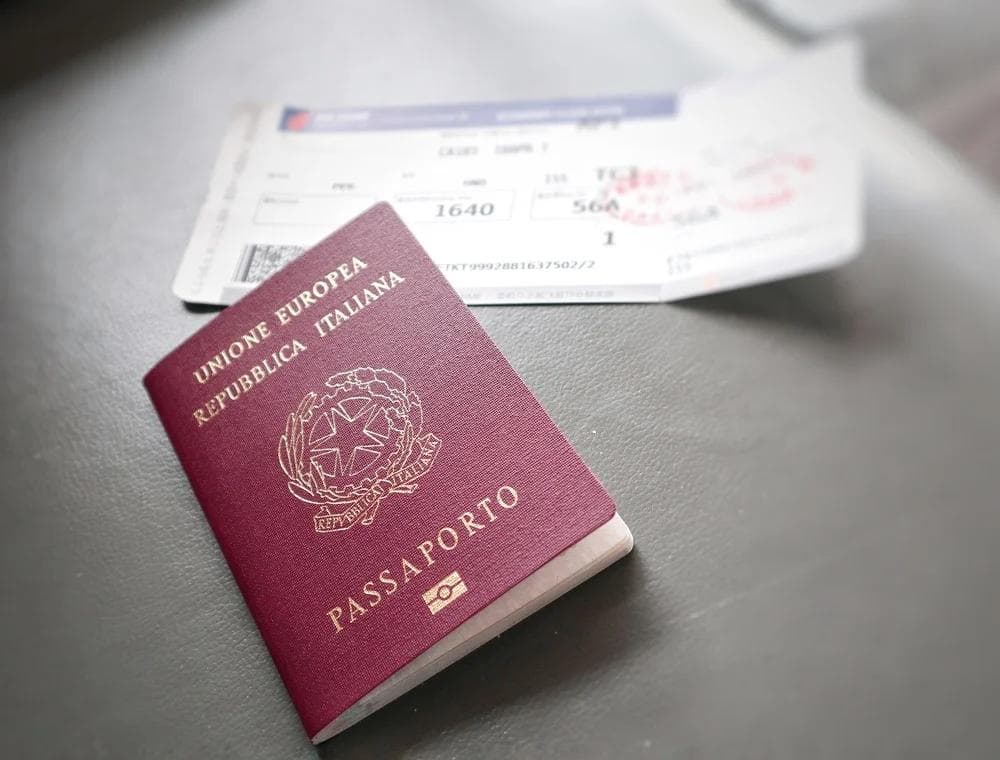
Documents for the visa application
Applying for the Italian Elective Residence Visa takes a full set of documents that demonstrate your eligibility and your readiness for long-term residence without employment.
These documents establish your financial stability, accommodation arrangements, and health insurance coverage.
Required documents
Prepare the following documents:
Completed visa application form: duly filled and signed.
Valid passport: with at least three months' validity beyond the intended stay.
Recent passport-sized photographs: meeting the Italian consulate's specifications.
Proof of financial stability: official letters from banks or financial institutions, plus tax returns for the last two years.
Proof of accommodation: a registered lease agreement or property deed in Italy.
Health insurance policy: private cover acceptable to your consulate, including medical-risk cover for Italy and any evacuation or repatriation cover the consulate asks for.
Visa application fee: €116 for the National Type D visa (Elective Residence). Consulates outside the eurozone charge the local-currency equivalent and update the amount periodically.
Police or criminal-record certificate, if requested by your consulate: issued by the relevant authority and apostilled or legalised where required.
Proof of civil status: if applicable, such as marriage or birth certificates for accompanying family members.
A stronger file pairs every claim with proof: recurring income in the applicant's name, official bank or pension letters, the last two years of tax returns, a registered Italian lease or deed, health insurance, and an intent letter that matches a real long-term residence plan.
Requirements are not identical across consulates. Check the page for the consulate with jurisdiction over your residence and treat its list as controlling for your application.
| Item | Cost (EUR) | Notes |
|---|---|---|
| National Type D visa fee | €116 | Local-currency equivalent is set and updated by each consulate |
| Residence permit (permesso di soggiorno) | €80.46 postal slip | Questura kit list for elective residence; covers the electronic card and permit contribution. Poste Italiane adds a €30 service fee; the €16 revenue stamp is separate |
| Revenue stamp (marca da bollo) | €16 | Required for the permit application |
| Private health insurance | Varies by age and cover | Policy must match the consulate's medical, evacuation and repatriation requirements |
| Document translation & legalisation | €200–€800 | Sworn translations plus apostille of civil and financial documents |
Proof of financial stability
Financial stability is central to the Elective Residence Visa application. The Italy retirement visa requires retirees to show substantial financial assets and stable income, enough to support themselves without working.
Official letters from banks, financial advisers, pension providers, Social Security agencies or similar institutions should verify your assets and recurring income. Consulates commonly ask for the last two years of tax returns as supporting evidence.
The income must come from passive sources, such as pensions or rental income, and cannot come from subordinate work. This documentation shows you can support yourself during your stay in Italy without employment.
Use the figures below as consular benchmarks, not a fixed statutory formula. Boston states more than €31,000 yearly per applicant; New York says family applicants typically need around €31,000 per person. Other consulates can apply their own evidence expectations, so confirm your jurisdiction before filing.
| Scenario | Official consulate benchmark | How to read it |
|---|---|---|
| Single applicant | About €31,000 a year in stable passive income | Boston says more than €31,000 yearly per applicant; New York uses around €31,000 per person for family applications. |
| Family applications | Adequate resources for every applicant or dependent included | Boston, New York and Los Angeles publish no percentage; the Abu Dhabi embassy checklist asks for at least 5% more income per child. The consulate handling your address can ask for its own evidence. |
| Conservative planning | Budget above the published benchmark | A complete file does not guarantee approval, and the consulate can request extra documents. |
Accommodation arrangements
You also need somewhere suitable to live. Long-term accommodation matters for the Italy retirement visa because it shows retirees have a stable base.
A registered lease agreement or property deed in Italy must show your lodging arrangements. Accommodation should cover the requested stay and look like genuine long-term housing; hotel bookings or informal third-party hospitality may not satisfy a consulate.
Finding a rental in Italy can be hard, especially for foreigners. A relationship with a rental agent can help you secure a compliant agreement. Proof of accommodation is a key part of your application, so handle it carefully.
Health insurance requirements
Health insurance is mandatory for the Elective Residence Visa application. Check the consulate list for the policy wording it expects. Some consulates refer to Schengen-style emergency, evacuation and repatriation cover; others may ask for broader private medical cover for Italy.
Use a policy that clearly names Italy, covers the full visa period, and can be shown again during the residence-permit process if the Questura asks for proof.
Step-by-step guide to applying for the Elective Residence Visa

Getting the Italian Elective Residence Visa runs through several steps. Each one needs attention to detail.
Preparing your application
Before applying, prepare the following:
- Document compilation: gather proof of financial stability, registered accommodation, health insurance, civil-status documents for family members, and any police or background certificate your consulate requests. Check that each document is current, translated and legalised where required.
- Timing: the Tashkent embassy checklist asks for the application no earlier than six months and no later than 15 days before travel (Tashkent embassy, checked 18 October 2026), so start gathering documents well before that window opens.
- Attention to detail: complete all forms accurately and make sure every supporting document is current and correctly prepared.
Submitting at the Italian consulate
Once your application is complete, the next step is submission:
- Consulate jurisdiction: submit to the Italian consulate that has jurisdiction over your place of residence. Verify you are applying to the correct one.
- In-person submission: the application form is signed in front of a consular officer. The Los Angeles consulate fingerprints all national (D) visa applicants from 11 January 2025 (Los Angeles consulate). Schedule an appointment and appear in person for this step.
- Additional requirements: be ready for any further interviews or medical examinations the consulate may request. These are standard checks on your eligibility.
Post-application procedures
After submission, several steps follow:
- Processing time: consulates can take up to 90 days. Los Angeles advises applying 90 days before departure and says rush processing is not possible; the Abu Dhabi and Tashkent checklists also give 90 days as the time limit.
- Approval and relocation: once your visa is approved, finalize your move to Italy and get the necessary documentation in order.
- Residence permit application: after you arrive in Italy with the long-stay visa, request the permesso di soggiorno within eight working days (Immigration Act art. 5(2), checked 18 October 2026). For elective residence the request goes through the Poste Italiane kit.
Following these steps closely, with attention to each phase, improves your chances of getting the Italian Elective Residence Visa and starting your move to Italy.
Obtaining your Italian residence permit
After you secure your Elective Residence Visa and arrive in Italy, complete the following steps to obtain your residence permit.
Steps upon arrival in Italy
The residence permit is the document that lets you remain in Italy after entry on the visa. Follow the local Questura or Poste Italiane instructions and keep the application receipt until the permit is issued.
EU long-term residence after five years
After five years of continuous legal residence in Italy, you may be eligible to apply for the EU long-term residence permit. This is a separate status with its own income, accommodation, integration, documentation and absence-limit conditions; it is not automatic because you held an Elective Residence permit.
This permit grants indefinite residency rights and makes travel within the EU easier. Eligibility includes stable and sufficient income, suitable accommodation, and adequate knowledge of the Italian language.
Registration with local authorities
- Start the permit process: for a long-stay visa holder, the key post-arrival step is the permesso di soggiorno application. Short-stay entry-stamp or reporting rules do not replace this process.
- Register your residence: go to the local municipality to register your residence. This involves providing proof of accommodation and is necessary to obtain a certificate of residence ( Certificato di Residenza).
Application for the residence permit
Gather the required documents, including:
Completed application form: duly filled and signed.
Valid passport with visa: with at least three months' validity beyond the intended stay.
Four recent passport-sized photographs: meeting the Italian consulate's specifications.
Proof of financial means: official letters from banks or financial institutions and tax returns for the last two years.
Proof of health insurance: private cover acceptable to the consulate and, if requested, the Questura.
Proof of accommodation: a registered lease agreement or property deed in Italy.
€16 electronic revenue stamp (Marca da Bollo): available at authorized tobacco shops or post offices.
- Visit a Poste Italiane branch offering the Sportello Amico service to obtain and submit the residence-permit application kit. After submission, you receive a receipt with an appointment date at the Questura.
- On the scheduled date, go to the Questura for fingerprinting and to complete the application. Bring all original documents for verification.
- Processing times vary. Once approved, you receive your Permesso di Soggiorno, typically valid for one year and renewable.
Completing these steps promptly keeps your stay in Italy legal and compliant with local regulations.
Tax implications and financial obligations
Tax matters for anyone holding an Elective Residence Visa in Italy. This section covers tax residency, taxation on worldwide income, and financial responsibilities in Italy.
Tax residency status
In Italy, tax residency is determined by several factors:
- Most of the tax year: since 2024 you are Italian tax resident if, for most of the tax year (counting fractions of a day), you have your civil-law residence or your domicile in Italy, or are physically present there (TUIR art. 2(2), as amended by D.Lgs. 209/2023).
- Registration: being registered in the National Registry of the Resident Population (Anagrafe) for most of the tax year creates a presumption of tax residence, which you can rebut with evidence.
- Domicile: domicile now means the place where your personal and family relationships mainly develop; if that is Italy, you can be tax resident even without registration.
Tax residency makes you liable for Italian tax on your global income.
Taxation on worldwide income
As a tax resident, Italy taxes your worldwide income, including:
- Employment income: salaries and wages earned globally.
- Investment income: dividends, interest, and capital gains from foreign investments.
- Rental income: earnings from properties located abroad.
Ordinary national IRPEF is progressive, with rates from 23% to 43%. Regional and municipal surcharges, deductions and substitute-tax regimes can change the final result.
Special tax regimes for new residents
Beyond the standard rates, two optional regimes can substantially reduce the tax a new resident pays on foreign income. Both are widely used by retirees and high earners who move to Italy.
| Regime | Tax treatment | Applies to | Duration | Key condition |
|---|---|---|---|---|
| 7% pensioner regime (Art. 24-ter) | Substitute tax on qualifying foreign income | Recipients of foreign pensions | First nine tax periods after the year it takes effect (per the law text) | Move to a southern or earthquake-zone municipality of up to 30,000 inhabitants; not Italian tax resident in the previous 5 years |
| New-resident lump-sum regime (Art. 24-bis) | Annual substitute tax on foreign-source income | High-net-worth new tax residents | Up to 15 years | €300,000 a year for transfers from 1 January 2026; not Italian tax-resident in at least 9 of the previous 10 tax years |
7% flat tax for foreign pensioners
Italy's 7% regime (TUIR art. 24-ter) is for people with foreign pension income who move their tax residence to a municipality of no more than 30,000 inhabitants (20,000 before 7 April 2026, per the Agenzia delle Entrate) in Sicily, Calabria, Sardinia, Campania, Basilicata, Abruzzo, Molise or Puglia, or to certain earthquake-zone municipalities. You must not have been Italian tax resident in the previous five tax periods and must move from a country with an administrative-cooperation agreement. It taxes all foreign-source income at 7%; the law says the option is valid for the first nine tax periods following the one in which it takes effect, so confirm the count with a tax adviser. The regime is separate from the visa; our 7% flat-tax service (from €1,250) checks eligibility and the town, then hands the file to a licensed Italian tax adviser (commercialista).
Lump-sum regime for high-net-worth new residents
Italy also has an Article 24-bis lump-sum regime for high-net-worth new residents who were not Italian tax resident in at least nine of the previous ten tax years (TUIR art. 24-bis). For people who transfer residence from 1 January 2026 the substitute tax is €300,000 a year on foreign-source income, plus €50,000 per family member included (Law 199/2025); earlier movers keep the amount that applied when they moved. See our neo-residents flat tax service.
Both regimes are optional, mutually exclusive and carry conditions, so take professional tax advice before relying on either.
Financial responsibilities in Italy
Beyond income tax, residents have other financial obligations:
- Social security contributions: mandatory for employed and self-employed individuals, paid into the national social security system.
- Municipal and regional taxes: local taxes vary by region and municipality, including property taxes and service fees.
- Foreign-asset taxes: residents generally pay IVIE on foreign real estate and IVAFE on foreign financial assets, and report foreign assets in the RW section of the tax return; the 24-bis option removes these obligations for those who elect it.
To handle these obligations, consult a tax professional familiar with Italian tax law.
Keeping and renewing your status
The Elective Residence Visa is the first step, not the finished status. To keep living in Italy, you need to renew the permit, keep proving passive income, insurance and accommodation, and understand that any later long-term residence application is a separate test.
Renewal requirements
Once issued, your residence permit (permesso di soggiorno) is valid for one year and is renewed annually, provided you meet specific conditions:
- Financial stability: you must keep showing enough passive income to support yourself without employment in Italy. Use the benchmark applied by your consulate or Questura, keep the income evidence current, and expect discretion rather than automatic renewal.
- Residence pattern: plan to live in Italy as your main home and avoid long unexplained absences. For renewal and any later EU long-term residence application, absences can matter; ask the Questura or an immigration professional how the current absence-limit rules apply to your facts.
- No employment: any form of paid work in Italy is prohibited under this visa category. Breaking this condition can lead to visa revocation.
- Application process: request the renewal at least 90 days before the permit expires (Immigration Act art. 5(4), checked 18 October 2026). Gather updated proof of income, health insurance and accommodation, then follow the Poste Italiane or Questura route that applies to your permit type.
Important considerations
Before applying for the Italian Elective Residence Visa, weigh a few points that affect a smooth move and compliance with Italian regulations.
Work restrictions
Holders of the Elective Residence Visa are strictly prohibited from any form of employment or professional activity within Italy.
This visa is for people who can support themselves through passive income such as pensions, investments, or rental income. Working can lead to visa revocation.
Regional variations
The Elective Residence Visa is a national program, but some administrative procedures and requirements vary by region or municipality.
For instance, registering your residence or obtaining a residence permit (permesso di soggiorno) can differ slightly depending on local rules.
Check with local authorities or seek legal help to handle these regional differences.
Tax obligations
Once you establish tax residency in Italy, you may be taxed on worldwide income. Ordinary national IRPEF is progressive, but local surcharges and special regimes can change the final result.
Italy also has tax treaties with various countries to prevent double taxation. Consult a tax professional to understand your specific obligations and stay compliant with Italian tax law.
Healthcare options
Healthcare access is worth planning:
- Private health insurance: at first you need private cover acceptable to the consulate and local immigration office. Verify the medical-risk, evacuation and repatriation wording before you buy.
- Public healthcare system (SSN): after you obtain a residence permit and register locally, ask the ASL whether voluntary SSN registration is available in your situation. For non-EU voluntary registration, the statutory minimum contribution is €2,000 a year unless a specific exception applies (Immigration Act art. 34(3), checked 18 October 2026).
Why applications are refused
Most refusals are not about one missing form. They come from a file that does not prove stable passive income, registered long-term housing, insurance acceptable to the consulate, current legalised documents, or a residence plan that looks permanent enough for this visa category.
Treat the published income figures as a floor, not a target. Build a file that shows recurring income in the applicant's name, a registered lease or deed, clean civil-status and background documents where requested, and a clear reason for settling in Italy. If your facts depend on remote work, active business income, short-term accommodation or long absences from Italy, get advice before filing.
Summary
The Italian Elective Residence Visa is a document-heavy route for people who can live in Italy from passive income without working. The strongest applications prove income, accommodation, insurance and long-term residence intent with clean, consulate-ready evidence.
For retirees and financially independent applicants, the route can work well, but it is discretionary. A consulate can still ask for more documents or refuse a file that only just meets a published minimum.
Start with the official consulate requirements for your jurisdiction, then build the file around your income, family scope, housing, health insurance, tax exposure and renewal plan.