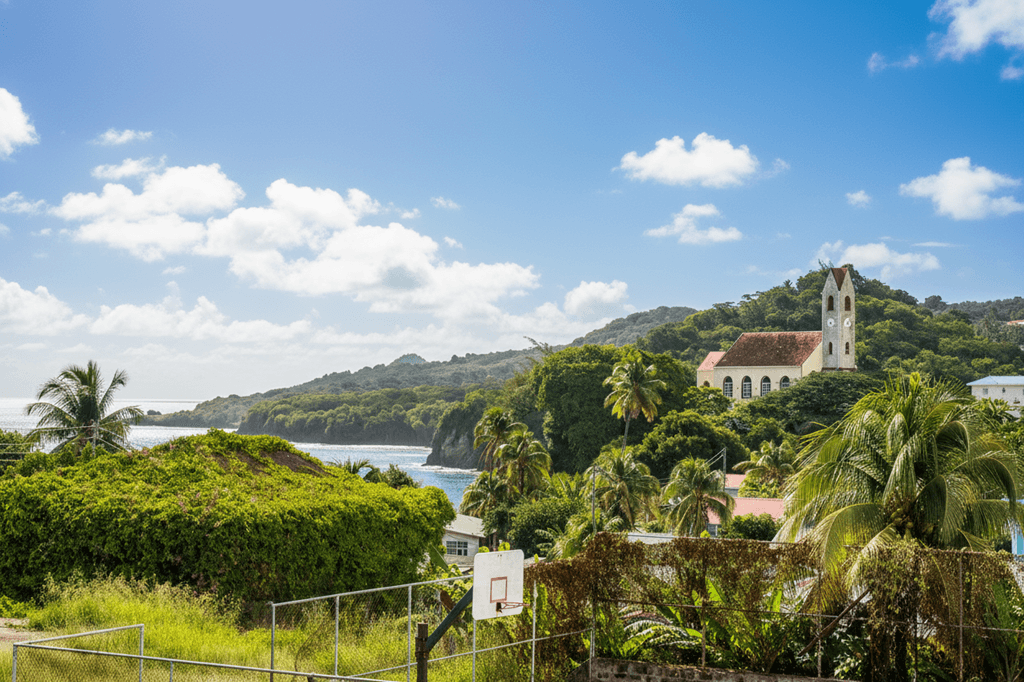
Grenada CBI in 60 seconds
Grenada citizenship by investment starts at USD 235,000: a one-time National Transformation Fund (NTF) contribution that covers a main applicant and up to three dependants, or an approved real estate investment from USD 270,000 for a share in a co-owned unit or USD 350,000 for full ownership, plus a USD 50,000 government contribution (IMA Grenada, checked 18 October 2026). Per-person application, due diligence, processing and interview fees come on top, and applications go only through authorised agents, never directly to the government. Grenada is a U.S. E-2 treaty country, but anyone who becomes Grenadian through investment and has never held E status needs three years of continuous domicile in Grenada before applying for an E visa (9 FAM 402.9 and 8 U.S.C. 1101(a)(15)(E)).
| Decision point | Current planning answer | Source or caveat |
|---|---|---|
| Lowest official route | NTF contribution from USD 235,000 before per-person fees and professional costs. | IMA Grenada fee schedule. |
| Real estate route | Approved real estate from USD 270,000 for co-ownership or USD 350,000 for full ownership, plus government contribution and transaction costs. | IMA Grenada fee schedule; project risk and resale liquidity need separate due diligence. |
| How to file | Applicants use authorised international marketing agents and authorised local agents. | IMA Grenada programme process. |
| Typical timing | IMA Grenada quotes three to six months; timing is not guaranteed. | Depends on documents, due diligence, interview scheduling, and investment completion. |
| E-2 angle | Grenadian nationality can support E-2 planning only if the applicant also meets U.S. visa rules. | State treaty-country list, USCIS E-2 guidance, and the statutory domicile caveat. |
Grenada CBI costs and investment routes
Start with the official IMA Grenada fee schedule, not with blended marketing totals. The investment amounts are set by the Grenada Citizenship by Investment (Amendment) Regulations, 2024 (SRO 12 of 2024, in force 1 July 2024): a National Transformation Fund contribution of USD 235,000, or approved real estate from USD 350,000 to buy a unit outright, or USD 270,000 for a share in a co-owned unit in an approved tourism-accommodation project valued at a total of at least USD 440,000 (SRO 12 of 2024 and IMA Grenada, checked 18 October 2026).
The same IMA page confirms the authorised-agent process and mandatory interview requirement. Treat the table below as the government-fee starting point before professional, banking, translation, certification, legalisation, property, and post-approval costs. Source: IMA Grenada.
Official government fee schedule
| Applicant case | National Transformation Fund route | Approved real estate route | Official fees to add |
|---|---|---|---|
| Single applicant | Required contribution: USD 235,000. | Approved real estate from USD 270,000 for co-ownership (a share of a unit valued at USD 440,000 or more) or USD 350,000 for full ownership, plus a USD 50,000 government contribution. | Application fee USD 1,500, due diligence fee USD 5,000 (the IMA FAQ lists USD 6,000), processing fee USD 1,500, and interview fee USD 1,000. |
| Main applicant plus spouse | Required contribution: USD 235,000. | Same real estate minimums, plus the listed real estate government contribution. | Application, due diligence, processing, and interview fees generally apply per adult/person as shown in the IMA fee table. |
| Family of four | Required contribution: USD 235,000 for the standard family case shown by IMA, except for siblings, parents, and grandparents aged 55 and under. | Same real estate minimums, plus the listed real estate government contribution, with dependant exceptions shown in the IMA fee table. | Application fees apply per person. Due diligence applies to applicants aged 17 and over. Processing is USD 1,500 for people aged 17 and over and USD 500 for people under 17. Interview fees apply to people aged 17 and over. |
| Additional dependants | IMA lists USD 25,000 / USD 50,000 per additional dependant after the third dependant, and USD 75,000 for an additional sibling. | Confirm the exact additional-dependant government contribution with the current IMA schedule and authorised agent before relying on a total. | Per-person application, due diligence, processing, and interview fees may still apply based on age and applicant type. |
| Real estate co-ownership | Not applicable. | Approved real estate from USD 270,000, usually a share of a co-owned approved-project unit valued at USD 440,000 or more. | Government contribution, due diligence, application, processing, interview, purchase, and ongoing project costs should be budgeted separately. |
| Real estate full ownership | Not applicable. | Approved real estate from USD 350,000 for full ownership in an approved project. | Government contribution, due diligence, application, processing, interview, purchase, and ongoing project costs should be budgeted separately. |
Source note: fee amounts in this table come from the IMA Grenada Becoming a Citizen page, checked 18 October 2026; the investment amounts match SRO 12 of 2024. The IMA's own FAQ page lists the due diligence fee as USD 6,000 per applicant aged 17 and over, against USD 5,000 in the fee table, so confirm the current figure with the authorised agent before paying. The IMA FAQ also says all fees are non-refundable.
Non-government costs to budget separately
| Cost type | Why it matters |
|---|---|
| Authorised-agent and professional fees | Applicants must use authorised programme agents. Advisory, tax, immigration, and regulated professional fees vary by case and provider. |
| Banking and transfer costs | International transfers, bank onboarding, compliance reviews, and payment verification can add time and cost. |
| Translations, certification, and legalisation | Non-English documents usually need certified translation and appropriate authentication before submission. |
| Real estate purchase costs | Project due diligence, share registration, transaction documents, insurance, maintenance, management, and resale liquidity should be reviewed before choosing property. |
| Post-approval passport and administration | Passport issuance, renewals, courier handling, and consular administration should be confirmed with the passport authority or authorised agent. |
Cost takeaway: the NTF route is usually simpler and easier to price. Real estate may suit applicants who want an approved project asset, but it carries project, holding-period, management-fee, and resale risk. Do not compare routes on headline investment amount alone.
Who is eligible for Grenada CBI?
Grenada CBI is built around applicant suitability, lawful source of funds, complete civil and financial documents, health screening, government due diligence, and the chosen investment route. The official application and form requirements sit with IMA Grenada; applicants should confirm any restricted-nationality or dependant edge case before filing.
Eligibility and family inclusion at a glance
| Applicant or family member | What the page should make clear | Evidence or caveat |
|---|---|---|
| Main applicant | Must be an adult applicant who can pass due diligence, document lawful source of funds, and meet the chosen investment route. | IMA forms and programme process. |
| Spouse | Can usually be included where the marriage and identity documents are complete and verifiable. | Confirm case-specific documents with the authorised agent. |
| Dependent children | Dependent children may be included where they meet the programme rules and document requirements. | Age, dependency, and education evidence matter. |
| Parents or grandparents | May be included where dependency and relationship evidence meet the rules. | Fee treatment can vary by age and dependant type. |
| Eligible siblings | May be possible in specific cases, but sibling rules and fees need careful confirmation. | Do not rely on a headline family total without checking the current IMA schedule. |
| Restricted or sensitive nationality cases | Some nationalities or residence histories may be restricted or require exception analysis. | Confirm directly with IMA or the authorised agent before preparing an application. |
Who should not use Grenada CBI?
Grenada CBI may not be suitable if you need immediate U.S. residence, cannot document lawful source of funds, have unresolved criminal, sanctions, or serious visa-refusal issues, want to file directly with the government, or need tax certainty without specialist advice in every relevant jurisdiction.
Application Process and Timeline
Required Documents
Each applicant must submit a complete set of personal, civil, financial, and supporting documents. All documents not in English must be accompanied by a certified English translation and authenticated with an apostille or notarial certification.
Source note: use the current IMA Grenada forms and document checklist as the filing baseline. Bank records, source-of-funds evidence, translations, notarisation, and real estate documents should be checked before submission, not after approval in principle.
What Forms Are Required?
| Form | Purpose |
|---|---|
| Form 1 | Personal data and applicant information |
| Form 2 | Fingerprints |
| Form 3 | Particulars for the Office of Home Affairs |
| Form 4 | Medical certificate, including HIV test results |
| Form 5 | Employment, business, and wealth declaration |
| Form 6 | Investment confirmation (NTF and real estate routes) |
| Thomson Reuters Consent | Mandatory for all applicants aged 16+ for due diligence |
| Passport Application | Required for each new citizen |
| Oath of Allegiance | Confirm the format with the authorised agent |
What Civil and Identity Documents Are Needed?
| Document | Requirements |
|---|---|
| Birth certificate | Original or certified copy; two copies required |
| Passport copies | Coloured; include all identification pages |
| National ID / Social Security | Required for each applicant |
| Marriage / Divorce certificate | If applicable; two certified copies |
| Name change proof | If applicable |
| Residence card / Proof | Permanent residence card or proof of residence |
| Passport photo | 35x45mm, plain background, JPEG or PNG format |
What Financial Evidence Is Required?
| Document | Requirements |
|---|---|
| Bank statements | 12 months of personal statements |
| Bank reference letter | Original, issued within last 6 months |
| Professional reference | From lawyer, accountant, or employer |
| Income verification | Payslips or salary verification letters |
| CV / Résumé | Detailed employment history |
| Address proof | Recent utility bill or lease agreement |
| Source of funds | Business registration, portfolio, tax returns, etc. |
Additional Family & Legal Documents
- Affidavit of support for dependants
- Affidavit confirming dependent parents’ names
- An affidavit from a spouse or ex-spouse regarding custody or consent for children
- Education certificates (for children over 18 in full-time education)
- Military service card (if applicable)
- Police clearance certificate from the applicant’s country of citizenship and residence (must be original and issued within six months)
Real Estate Route (if applicable)
| Document | Requirements |
|---|---|
| Purchase and Sale Agreement | Four copies required |
| Escrow Agreement | With local agent or developer |
| Letter of Engagement | With local agent or developer |
| Payment proof | Investment payment or escrow transfer confirmation |
Certification & Translation Rules
All non-English documents must be translated and certified by a licensed translator. The notary or lawyer providing certification must attach their professional licence copy to each document.
Minimum Stay Requirement
There is no residency or visit requirement in force for Grenada's programme today: IMA Grenada says you do not need to visit Grenada before, during or after the application (IMA Grenada FAQ, checked 18 October 2026). That may change. The Grenada Citizenship by Investment (Amendment) Bill, 2026 would require each new citizen to commit to an aggregate of at least 30 days' physical presence in Grenada in the first five calendar years after citizenship (the family can meet the total together, but each person must spend at least 5 days in Grenada in the first 12 months) and to a mandatory integration programme. It would apply to applications submitted after the regional ECCIRA Agreement Act comes into force, and the Minister could also apply it to pending applications. It comes into force only on a date the Minister appoints by order in the Gazette, and IMA Grenada's pages did not show it in force on 18 October 2026, so ask the authorised agent for the current position before you apply.
U.S. E-2 visa planning caveat
Grenada has been an E-2 treaty country since 3 March 1989, for treaty investors only, not E-1 traders (9 FAM 402.9, checked 18 October 2026). That does not make Grenada CBI a U.S. residence route. USCIS still requires the applicant to qualify for E-2 classification, and since 23 December 2022 8 U.S.C. 1101(a)(15)(E) has required anyone who acquired the treaty nationality through a financial investment, and has not previously been granted E status, to have been domiciled in that country for a continuous period of at least three years at any point before applying. Congress added that rule in section 5902 of Public Law 117-263.
| E-2 question | Practical answer | Source |
|---|---|---|
| Is Grenada an E-2 treaty country? | Yes. Grenada appears on the State Department treaty-country list. | U.S. Department of State treaty-country table. |
| Does CBI create U.S. residence? | No. Grenada CBI is not a green card, not U.S. residence, and not a visa approval. | USCIS E-2 guidance. |
| What does E-2 still require? | A qualifying treaty-country national, a substantial investment in a real U.S. enterprise, and the other E-2 eligibility requirements. | USCIS E-2 guidance. |
| What is the domicile caveat? | Investment-naturalised treaty nationals who have not previously held E status generally need three years of continuous domicile in that treaty country before E-2 filing. | 8 U.S.C. 1101(a)(15)(E). |
| When is Grenada useful? | When the applicant can plan the domicile period, document the investment, and accept that U.S. visa approval remains discretionary. | Planning caveat, not a guarantee. |
Practical takeaway: Grenada's E-2 angle is a planning advantage, not a shortcut. It is useful only where the applicant can plan around U.S. visa rules, the three-year domicile caveat, business investment evidence, and family timing. Our guide to Grenada citizenship and the U.S. E-2 visa walks through the domicile rule and the costs.
What Happens After Approval?
Grenadian citizenship is permanent and, under the rules in force on 18 October 2026, does not carry residency or visit obligations once granted. If the 2026 amendment described above comes into force, new citizens would have to meet its 30-day presence and integration commitments.
The main ongoing administrative obligation is passport renewal through the standard renewal process. Confirm the current validity period, renewal documents, and fees with the passport authority, consulate, or authorised agent before relying on a renewal timeline.
For those who obtained citizenship through the real estate route, the approved-project investment must be held for at least five years before it can be resold. Ask the authorised agent what happens if the project or a sale falls through before then, and build the project's management and resale terms into your decision.
Grenadian citizens are encouraged to keep their contact details and documentation up to date with local authorities to ensure seamless passport renewal and consular support when needed.
Passport Validity and Renewal
Grenadian citizenship is permanent once granted, but passports still need renewing. IMA Grenada says Grenadian passports are valid for five years and can be renewed through the Grenada consulate in London or the Passport and Immigration Office in Grenada (IMA Grenada FAQ, checked 18 October 2026). Confirm the renewal documents and fees before travel, especially for children and dependants.
| Feature | National Transformation Fund (NTF) | Approved Real Estate |
|---|---|---|
| Minimum Investment | USD 235,000 (non-refundable) | USD 270,000 (co-ownership, unit USD 440,000+) or USD 350,000 (full ownership) |
| Government Contribution | Included in the main contribution | USD 50,000 (for main applicant + up to 3 dependents (4 people total)) |
| Total Upfront Capital (Illustrative) | About USD 257,000 for two adults and two children under 17 (USD 235,000 plus USD 22,000 per-person fees at fee-table rates) | About USD 342,000 (co-ownership) or USD 422,000 (full ownership) for the same family, incl. the USD 50,000 government contribution and per-person fees |
| Investment Recoverability | No (Donation) | Yes, after 5 years via resale |
| Potential for ROI | None | Possible rental income or resale value, not guaranteed |
| Risk Profile | Low (Financial certainty) | Higher (Market, liquidity, operational risks) |
| Holding Period | N/A | 5 years mandatory |
| Complexity | Simple, one-time transaction | More complex, involves property law and management |
Visa-Free Travel and Passport Benefits
Grenadian citizenship offers visa-free, visa-on-arrival or electronic-authorisation access to 148 destinations, which ranks Grenada 27th in the 2026 Henley Passport Index (Henley & Partners, checked 18 October 2026).
On the same index Grenada has climbed from 34th in 2023 to 27th in 2026.
What Are the Notable Visa-Free Destinations?
| Destination | Access Type | Duration |
|---|---|---|
| United Kingdom | Visa-free (ETA required)* | Up to 6 months |
| Schengen Area (29 countries) | Visa-free | 90 days / 180 days |
| China | Visa-free | Up to 30 days |
| Singapore | Visa-free | 30 days |
| Hong Kong | Visa-free | 90 days |
| Russia | Electronic authorisation (Henley 2026 data) | Check before travel |
| Brazil | Visa-free | 90 days |
*UK travel rules have changed. Grenadian citizens should check the current GOV.UK Electronic Travel Authorisation (ETA) guidance before travel; GOV.UK currently lists the ETA fee at £20 and says an ETA lets eligible visitors travel to the UK for up to six months but does not guarantee entry.
Grenada tax points to verify
Tax planning around Grenada citizenship should be handled carefully. Citizenship alone does not decide tax residence, source-of-income treatment, reporting obligations, estate treatment, or home-country tax exposure. Use Grenada Inland Revenue Division pages as a starting point, then get Grenada and home-country tax advice before restructuring assets or relying on a tax outcome.
| Issue | What the source trail supports | How to treat it |
|---|---|---|
| Income tax | Earlier IRD guidance described income tax as a tax on chargeable income of individuals, corporations, or other legal entities, with assessable income tied to source rules. | Analyse residence, income source, entity structure and home-country rules before making any foreign-income or company-tax claim. |
| VAT | Earlier IRD guidance described VAT, including a 10% rate for tourism and accommodation services and zero-rated or exempt goods and services. | Do not summarize VAT as one flat rate without checking the supply, exemption status, and filing position. |
| Property tax | Earlier IRD guidance described property tax as an ad valorem tax assessed at market value with rates based on land-use classification. | Confirm the property category, building/land split, exemption position and current rate for the exact asset. |
| Tax residence | This audit did not verify a simple day-count tax-residence test from an official source. | Do not rely on a citizenship-only or day-count-only conclusion. Confirm Grenada residence rules and home-country residence rules with a qualified adviser. |
| Estate and wealth taxes | This audit did not verify an official source for a blanket no-inheritance-tax or no-wealth-tax claim. | Treat estate, wealth, domicile, succession and reporting consequences as adviser questions in every connected jurisdiction. |
The Inland Revenue Division's former tax pages (update.ird.gd) no longer load (checked 18 October 2026), so the descriptions in this table reflect earlier IRD guidance. Confirm current rates and rules directly with the Inland Revenue Division or a Grenada tax adviser. These categories do not settle an applicant's worldwide tax position by themselves.
Legal Framework and Programme Background
Programme background
Grenada citizenship by investment is a government programme under the Grenada Citizenship by Investment Act, No. 15 of 2013, that grants citizenship by registration to applicants who make a qualifying NTF contribution or approved-project investment and pass due diligence. It is administered by the Investment Migration Agency (IMA Grenada, formerly the Citizenship by Investment Unit); the Citizenship by Investment Committee reviews each file and recommends a decision to the Minister responsible for citizenship, who has the final say (IMA Grenada, checked 18 October 2026).
Through this programme, eligible individuals can obtain Grenadian nationality by making an approved investment in either the National Transformation Fund (NTF) or a government-approved real estate project. The official IMA guidance identifies these as the two investment routes, and applications must be submitted through authorised agents.
Since its launch in 2013, the programme has been updated through regulations and official circulars. Applicants should check the current IMA fee schedule and forms before applying, because fees, dependant rules, and due diligence requirements can change.
Citizenship granted under this framework is lifelong, can be passed to future generations, and does not require renunciation of any existing nationality. Grenada recognises dual and multiple citizenship, allowing investors to retain their original passports while enjoying the privileges of being Grenadian citizens.
Legal framework
The Act is supported by regulations made by the Minister. The IMA's legal page lists the Act, its amendments and the regulations, including the Grenada Citizenship by Investment (Amendment) Regulations of 2025 (SRO 21 of 2025).
The investment amounts in force today come from SRO 12 of 2024, in force 1 July 2024. SRO 21 of 2025, gazetted 21 March 2025, changed the developer fees and equity rules for approved projects, with lower fees for Grenadian developers; it did not change the applicant contribution amounts. The Grenada Citizenship by Investment (Amendment) Bill, 2026 would add oversight by the Eastern Caribbean Citizenship by Investment Regulatory Authority (ECCIRA) and the 30-day presence rule once it is brought into force.
Citizenship acquired through investment is lifelong and inheritable, enjoying the same status as citizenship by birth under the Constitution of Grenada. Revocation applies only in serious cases, such as fraud, concealment of facts, or national security threats, reinforcing the program’s integrity.
Grenada also permits dual and multiple citizenships, allowing investors to retain their existing nationality without renunciation. This flexibility provides both personal freedom and practical benefits for global mobility, asset management, and tax planning.
Why Applicants Consider Grenada CBI
Grenada is strongest for applicants who want a government CBI route with clear official fees, broad family planning, no residence requirement during the application, and a possible long-term U.S. E-2 treaty strategy. It is weaker for applicants who want the lowest possible Caribbean CBI cost, immediate U.S. access, guaranteed timing, or tax certainty without specialist advice.
How Does Grenada Compare to Other Caribbean CBI Programmes?
Use this table as a directional screen, not as a substitute for current official fee schedules. The practical question is not only which country has the lowest headline contribution; it is which programme fits the family, timing, due diligence, tax, and mobility goal. Our citizenship by investment guide compares programmes worldwide, and the Grenada CBI statistics page tracks published application data.
| Programme | Headline minimum | Typical planning range | U.S. E-2 treaty angle | Best fit |
|---|---|---|---|---|
| Grenada | USD 235,000 NTF | IMA quotes 3-6 months | Yes, with three-year domicile caveat for many investment-naturalised applicants | Applicants who value E-2 planning, family inclusion, and no residence filing requirement. |
| St. Kitts & Nevis | Often higher headline contribution | Varies by route and due diligence | No | Applicants prioritising a long-running Caribbean CBI programme and different passport-mobility mix. |
| Dominica | Often lower headline contribution | Varies by route and due diligence | No | Applicants focused mainly on lowest-cost Caribbean CBI screening. |
| Antigua & Barbuda | Often competitive for families | Varies by route and due diligence | No | Families comparing donation, university, and real estate structures. |
| St. Lucia | Often competitive by route | Varies by route and due diligence | No | Applicants comparing bond, enterprise, contribution, or real estate options. |
Choose Grenada if...
- E-2 planning matters and you can plan around the U.S. domicile caveat.
- Family inclusion matters and your dependants fit the official rules.
- You want a no-residence CBI filing process handled through authorised agents.
- The official NTF or real estate cost structure fits your budget after all professional and transaction costs.
Avoid Grenada if...
- You need immediate U.S. residence, a green card, or immediate E-2 filing after naturalisation.
- You want the lowest possible Caribbean CBI headline cost.
- You cannot prove lawful source of funds or explain your wealth history clearly.
- You want to file directly with the government instead of using authorised programme agents.
- You need tax outcomes without specialist advice in every relevant jurisdiction.
How Movingto helps with Grenada CBI planning
Movingto is a Portugal-first immigration firm that puts a named, Bar-registered lawyer from its in-house legal team on your case and publishes its fees.
Movingto helps applicants decide whether Grenada CBI is the right route before they commit to an official application path. The work is route-fit, cost context, document preparation questions, source-of-funds readiness, E-2 planning context, and what to ask the authorised agent who files.
Role boundary: Movingto is not the authorised local submitting agent for Grenada CBI. Formal programme submissions must be handled through authorised programme agents and local agents. Our guide to choosing a Grenada citizenship by investment law firm shows how to check an agent's licence on the official IMA list.
| Decision stage | What Movingto helps with | What the authorised programme agent handles |
|---|---|---|
| Route fit | Compare NTF, real estate, family inclusion, tax questions, timing, and E-2 planning value. | Confirm programme eligibility and submit through the official channel. |
| Cost clarity | Separate government fees, due diligence fees, professional fees, bank costs, and real estate costs before the applicant chooses a route. | Confirm the current IMA schedule and collect official programme payments. |
| Document readiness | Identify likely document, translation, certification, and source-of-funds questions early. | Review the formal submission pack and lodge it with IMA. |
| E-2 planning | Explain the domicile caveat and where U.S. immigration counsel may be needed. | The authorised Grenada agent does not guarantee U.S. visa approval. |
| Risk check | Flag cases where Grenada may not fit because of timing, tax, due diligence, nationality, or direct-filing expectations. | Escalate programme-specific eligibility issues through authorised channels. |
Our commitment
We do not present Grenada CBI as a shortcut. We explain the official rules, real costs, E-2 limitations, source-of-funds burden, and authorised-agent boundary before you decide whether to proceed.